
The Internet Was Supposed to Save Us: Queer Survival, Doomscrolling, and Digital Exhaustion
By: Dani Gagnon, Registered Psychotherapist (Qualifying)
I wake up most mornings the same way now: not to an alarm, but to a low-grade awareness that something terrible has probably happened while I was asleep.
Before my feet touch the floor, I already know the shape my hand will make reaching for my phone. I know the posture. Neck bent slightly forward. Eyes half open. Thumb moving almost automatically across glass. The weight of it sitting on my pinky finger. It feels less like checking the news and more like taking attendance inside the apocalypse.
Overnight, another anti-trans bill has advanced in the United States. A state legislature somewhere has debated whether people like me should be allowed to exist comfortably in public. A queer teenager has posted a video crying in their car after being disowned by their parents. There are new images from Gaza. Another climate disaster. A video about rising authoritarianism in Europe. Another headline about Meta data centres. Another act of violence against a visibly queer person. Another billionaire explaining why empathy is inefficient.
Between all this: moisturizer ads. A clip from Love Island. Somebody making protein bagels. Did Amanda and West from Summer House start sleeping together before February?
The human brain should not have to metabolize this much contradiction before coffee.
I am a queer and gender-fluid therapist working primarily with queer clients, though “working with” is beginning to feel too clean a phrase for the strange emotional ecosystem many of us now inhabit together. Increasingly, it feels as though my clients and I are trying to navigate the same storm while pretending the office walls are waterproof.
Some days, a client will sit across from me and describe a fear that sounds deeply personal until we trace its roots and discover it has been shaped, reinforced, and amplified by thousands of tiny digital exposures. Fear of abandonment sharpened by algorithmic dating culture. Fear of aging under economies that reward permanent self-optimization. Fear of being visibly queer while political leaders openly debate our humanity. Fear that the world itself is becoming unlivable.
These fears are not irrational. This is what makes the current moment psychologically difficult to discuss honestly. The language of mental health often encourages us to locate distress entirely within the individual: your anxiety, your thought patterns, your nervous system. But what happens when the environment itself has become genuinely destabilizing? How can we reframe it?
It is difficult to explain to somebody outside queer communities what the internet once represented for many of us. Younger queer people inherited a digital world already fully monetized, but I still remember an earlier version of the internet that felt almost accidental in its intimacy. Before every platform became aggressively optimized for engagement, online spaces often functioned like hidden corridors between isolated people.
I grew up during a period when many queer and gender-diverse people first encountered themselves online. Entire emotional vocabularies were built collaboratively between strangers. You could spend years feeling vaguely alien in your own life, then suddenly encounter somebody on Tumblr, Reddit, or an obscure YouTube channel describing your internal world with terrifying precision. The internet allowed many of us to imagine futures that did not exist in our immediate environments. It offered survival through recognition.
I sometimes think about how many queer adults are alive because another queer person once posted honestly online.
There is a tendency among older generations to speak about internet life as inherently shallow, but for marginalized communities, digital space has often been profoundly material. Online friendships became housing leads, emergency fundraising, safety planning, mutual aid networks, gender education, and emotional lifelines. During periods when political rhetoric grows openly hostile toward LGBTQIA2S+ people, these networks become even more essential. In recent years, as anti-trans legislation escalates across the United States and right-wing movements gain power internationally, queer people online are not simply reacting to politics. Many are monitoring the conditions of their own survival in real time.
The problem is that the internet no longer merely connects people. It extracts from them.
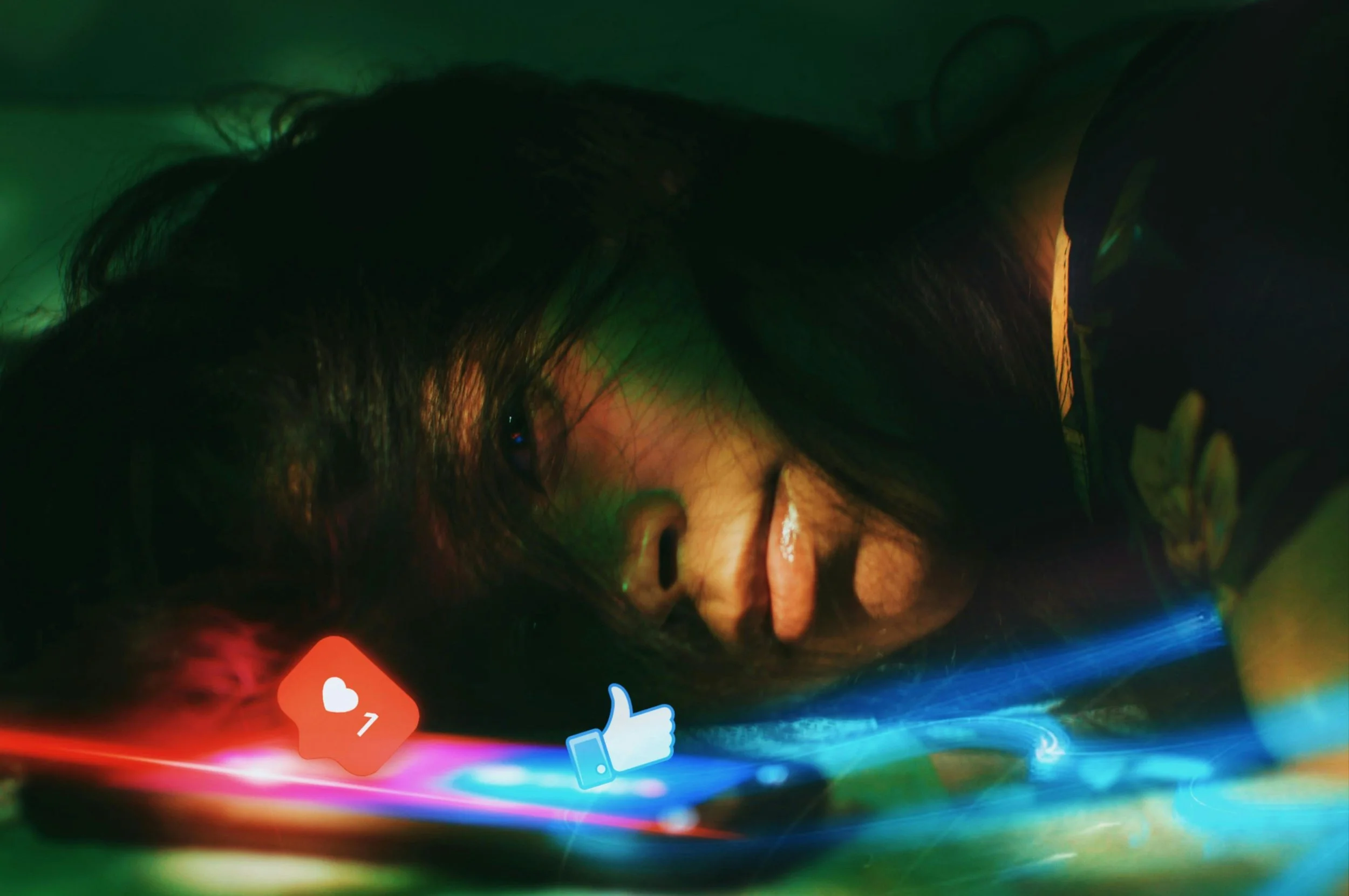
Before becoming a therapist, I worked in digital marketing for years. This means I have spent a significant portion of my adult life studying attention professionally. I know how platforms are designed to interrupt thought patterns. I know what kinds of headlines produce emotional activation. I know how outrage increases engagement, how certainty spreads faster than nuance, how fear keeps people scrolling. Entire industries now depend on maintaining a state of continuous psychological arousal.
The phrase doomscrolling sounds almost comical until you think seriously about what it describes. Human beings repeatedly exposing themselves to distressing information long past the point of usefulness. Continuing to consume images, headlines, and emotional shocks despite experiencing obvious psychological exhaustion. Returning again and again to the site of injury as though the next swipe might finally produce resolution.
But there is no resolution waiting at the bottom of the feed.
Only more feed.
As a therapist, I increasingly notice that many people no longer experience stress as episodic. Stress used to move in identifiable waves. You had a conflict, a crisis, a loss, then eventually some degree of recovery. Now many people exist in states of ongoing ambient activation. Their nervous systems are never entirely off-duty because the modern internet has collapsed the distance between personal life, political catastrophe, and global trauma.
A client opens TikTok before bed and encounters a video explaining attachment wounds, followed immediately by footage of civilian casualties overseas, followed by a skincare routine, followed by economic collapse statistics, followed by a lesbian comedian joking about antidepressants. The emotional whiplash itself becomes normalized.
Meanwhile, queer people are often expected to remain politically alert at all times because disengagement carries real consequences. There is a particular exhaustion that comes from existing as both a person and a political talking point simultaneously. Every election cycle seems to resurrect public debate over our legitimacy, our healthcare, our families, our bodies, our children, our right to participate safely in public life. Even from Canada, many queer people closely monitor political developments in the United States because American cultural and legislative movements rarely stay contained within borders. Authoritarian rhetoric travels extremely well online.
So we keep watching.
Partly because vigilance has historically kept marginalized people alive.
Partly because witnessing suffering feels morally necessary.
Partly because the algorithms have learned that fear is difficult to look away from.
The internet has created a strange moral confusion around attention. Many people now feel guilty for not consuming enough suffering. To look away from violence, injustice, or political collapse can feel irresponsible, even cruel. But endless exposure does not necessarily deepen understanding. Often, it simply overwhelms the body.
Therapy language has become increasingly mainstream online, which is both genuinely helpful and deeply concerning. On one hand, more people now possess language for trauma, boundaries, dissociation, abuse, and emotional regulation. This matters. Naming an experience can fundamentally alter a person’s ability to survive it. But social media also transforms psychological language into identity performance and consumer branding with startling speed. Healing becomes aestheticized. Self-awareness becomes content. Vulnerability becomes algorithmically rewarded so long as it remains legible and consumable.
Sometimes I worry we are losing the distinction between witnessing emotion and processing it.
The body, unfortunately, does not care whether emotional exposure arrives through direct experience or a glowing rectangle at two in the morning. It still releases stress hormones. It still learns vigilance. It still adapts itself around perceived danger.
And queer people, historically, are already highly practiced at vigilance.
Many LGBTQIA2S+ people grow up monitoring environments closely for signs of rejection or threat. We learn early how to read rooms, anticipate reactions, soften ourselves strategically, locate exits. Hypervigilance is often framed clinically as dysfunction, but for many marginalized people it began as adaptation. The problem is that digital life has industrialized this process. We are no longer scanning one room for danger. We are scanning the entire world continuously.
I notice this in myself sometimes.
I will open my phone meaning only to check the weather and emerge forty minutes later emotionally altered by events occurring thousands of kilometres away. My body does not fully understand the difference between witnessing and participation. A video filmed in another country can still leave residue in my nervous system hours later. A political speech in Florida can still tighten my shoulders in Toronto. A comment section can still feel physically unsafe. I see the word “noose” more times in my comment section than I want to admit.
This is not because queer people are fragile.
It is because humans were never designed to maintain intimate psychological proximity to this many people, crises, and threats simultaneously.
And yet, despite all this, I cannot bring myself to fully condemn the internet. That would require erasing too much of what it has given people like me.
The internet taught me that queer life could be expansive. It introduced me to art, language, politics, humour, relationships, and possibilities I may never have encountered otherwise. It allowed isolated people to find one another across geography, religion, family systems, and borders. It still provides lifelines every day. Somewhere tonight, a young queer person is discovering that their future may be larger than the world immediately surrounding them.
That matters.
What frightens me is not connection itself, but the systems now governing it. We built digital spaces searching for community and accidentally created economies dependent on emotional exhaustion. The same technologies that allow marginalized people to survive increasingly profit from keeping those same communities afraid, reactive, visible, and permanently online.
Sometimes, late at night, after hours of scrolling through political updates and increasingly surreal headlines, I think about the word exposure. In therapy, gradual exposure can help reduce fear. Repeatedly encountering something survivable teaches the nervous system safety.
But there is another kind of exposure that simply wounds through accumulation.
Too much grief.
Too much vigilance.
Too many realities colliding against each other without pause.
The feed refreshes endlessly because the world does.
And still, every morning, my hand reaches for the phone before I am fully awake, as though somewhere beneath all the noise there might still be proof that we are finding each other faster than we are falling apart.